
Table of Contents
Which ABA Strategies at Home Are the Most Useful for Parents and Caregivers?
Parents often wonder what they can do between ABA sessions to help their child continue building important skills. Fortunately, effective ABA strategies at home do not require turning your living room into a therapy space or making every family interaction instructional.
With guidance from your child’s BCBA, practical ABA strategies for parents can fit naturally into breakfast, playtime, getting dressed, errands, and bedtime. These ABA therapy techniques can support communication, independence, flexibility, and other individualized goals in a fluid and organic way.
Keep reading this blog by Texas ABA Centers as we explain how the most useful autism parent strategies are realistic, sustainable, and designed around your child’s unique needs, alongside some great tips to practice at home with your kid and family. Let’s dive in!
Why Are ABA Strategies at Home Important?
ABA strategies at home give children opportunities to practice emerging skills in the environments where they actually use them. This can help bridge the gap between formal ABA sessions and everyday family life.
A clinical review published in Pediatric Clinics of North America explains that caregiver-mediated interventions can support social communication and help families learn behavioral approaches for challenging situations. The research also emphasizes adapting support to family needs and available resources.
That distinction matters. Effective ABA strategies for parents should support families, not overwhelm them. When ABA therapy techniques are simple enough to use consistently, everyday routines can become natural learning opportunities.
Strong autism parent strategies work alongside family life rather than replacing it.
What ABA Therapy Techniques Can Parents Use During Daily Routines?
Many useful ABA therapy techniques can be incorporated into routines your family already follows. Rather than setting aside a separate “therapy hour,” parents can identify situations where a particular skill naturally belongs.
Consider these seven approaches with guidance from your child’s BCBA:
- Reinforce meaningful communication. Respond when your child appropriately asks for help, a break, or an item using the communication method their clinical team is teaching.
- Offer manageable choices. Snacks, clothing, and play activities can provide opportunities for communication and decision-making.
- Model the skill first. Show your child what an action or response looks like before expecting independence.
- Prepare for transitions. Visual schedules, timers, consistent routines, or advance warnings may help some children understand what comes next.
- Practice one step at a time. Gradually encourage independence during dressing, cleanup, hygiene, or other routines.
- Observe patterns. Note what happens before and after recurring difficulties, then share those observations with the BCBA.
- Practice skills in new situations gradually. When appropriate, help a skill move beyond therapy into family and community settings.
Autism Parenting Magazine also describes home activities involving reinforcement, visual supports, familiar routines, preferred interests, and everyday materials.
The goal is not to copy internet activities exactly. Appropriate ABA strategies at home should connect directly to your child’s individualized treatment plan.
How Can ABA Strategies at Home Feel More Natural?
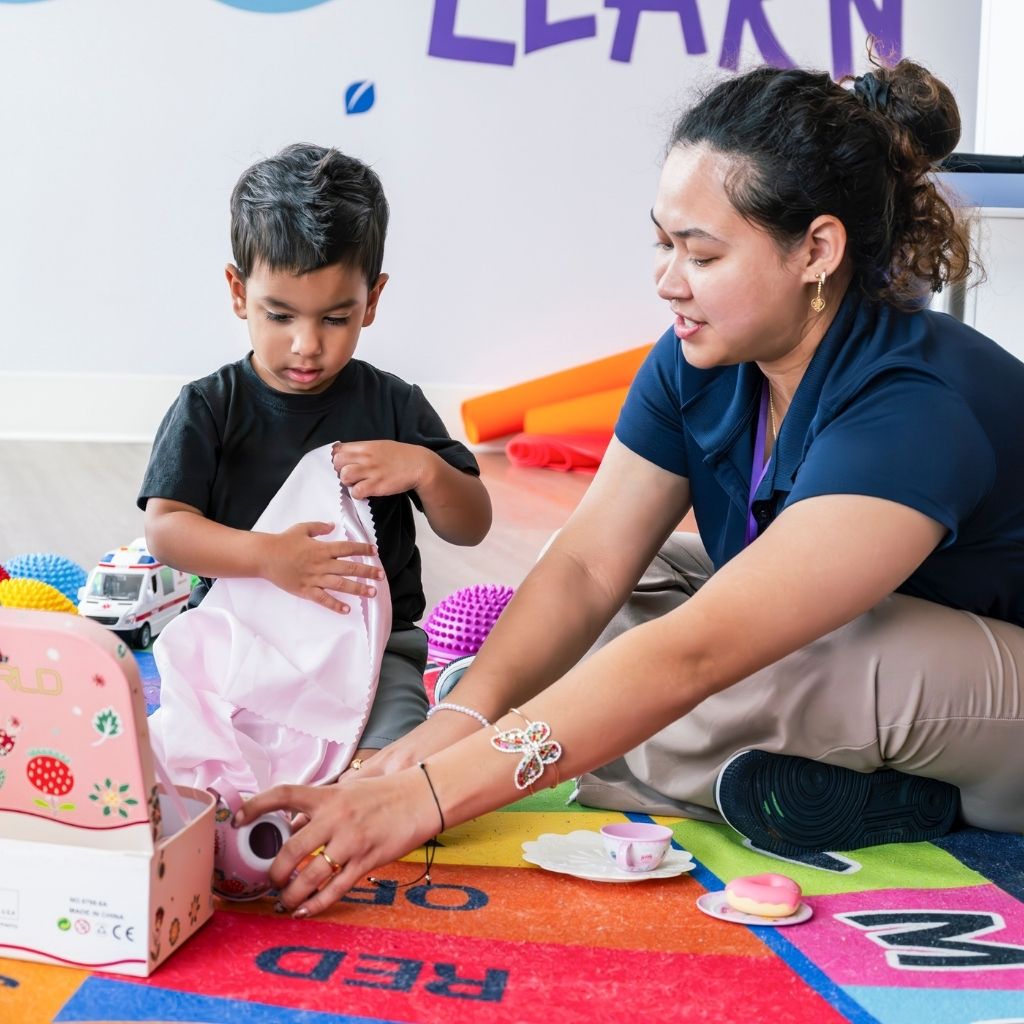
The best ABA strategies at home often happen during activities your family already does every day.
If your child is learning to make choices, breakfast might offer two options. If independence is a goal, getting dressed can provide an opportunity to complete one step with less assistance.
Goal | Activity / Action to Encourage |
Make choices | Offer two breakfast options and encourage your child to choose one. |
Build independence | Let your child complete one step of getting dressed with less assistance. |
Request help | Pause during a challenging activity and encourage your child to ask for help. |
Follow directions | Give a simple instruction, such as putting a toy in a bin, and praise your child for following it. |
Practice communication | During snack time, encourage your child to request a preferred food or drink. |
Develop turn-taking | Take turns adding pieces to a puzzle or building with blocks. |
Improve transitions | Use a visual or verbal reminder before moving from playtime to cleanup. |
Strengthen daily living skills | Encourage your child to place dishes in the sink after a meal. |
Increase social interaction | Practice greeting a family member or responding when someone says hello. |
Encourage problem-solving | Offer gentle prompts while your child works through a difficult puzzle or task. |
A 2025 study examining parent and caregiver involvement in home-based ABA programming highlights both the opportunities and challenges families experience when implementing strategies at home. Caregivers often balance treatment recommendations with work, household responsibilities, siblings, and other demands.
That is why sustainable ABA strategies for parents matter. The right ABA therapy techniques should be practical enough to use in everyday life, not only under ideal circumstances.
Effective autism parent strategies might involve practicing one meaningful skill consistently instead of trying to address several goals at once.
How Do ABA Strategies for Parents Support Generalization?
An important goal of ABA strategies for parents is helping children use learned skills across different people, settings, and situations. In ABA, this process is often called generalization.
For example, a child might first learn to request help with an RBT. Later, the child may practice using that same communication response with a parent, grandparent, teacher, or another caregiver.
Autism experts discuss how home- and community-based services can create opportunities for parent training and help skills generalize across environments.
For families in Texas, that might eventually include practicing communication, waiting, flexibility, or independence during a grocery trip, a family gathering, a playground visit, or other familiar community experiences.
Introduce these ABA therapy techniques thoughtfully. Helpful ABA strategies at home are not about repeatedly testing children. They are about giving them appropriate opportunities to use meaningful skills in real life.
Which Autism Parent Strategies Require Professional Guidance?

Don’t try every behavioral strategy on your own. Autism parent strategies should remain connected to your child’s individualized ABA treatment plan, particularly when challenging behavior is involved.
Parents can often reinforce communication, support routines, and practice clinician-recommended skills. However, complex behavior-reduction procedures should not be copied from social media, another family, or a generic online example.
The same behavior may occur for different reasons. If behavior is persistent, severe, unsafe, or changes unexpectedly, contact your child’s BCBA before trying more complicated ABA therapy techniques.
Good ABA strategies for parents involve collaboration. Parents bring essential knowledge about what happens throughout the child’s daily life, while clinicians provide expertise in assessment and intervention. Combining both perspectives can lead to more individualized autism parent strategies.
How Can Texas Families Keep ABA Strategies at Home Manageable?
Texas families balancing work, school, appointments, siblings, and daily responsibilities need achievable ABA strategies at home.
Start small. Choose one routine and one skill. Ask your BCBA which ABA strategies for parents would be most useful to practice, what the desired response should look like, and how much assistance your child needs.
For example, a family might focus on requesting help during play for one week instead of introducing several new ABA therapy techniques at once.
Whether your family lives in the Austin, Cedar Hill, or Sugar Land area, the principle is the same: treatment should fit the child and family, not the other way around. Sustainable autism parent strategies should leave room for play, rest, connection, and ordinary family experiences.
If certain ABA strategies at home are not working well for your family, tell your BCBA. That information can help the clinical team adjust recommendations or identify another approach.
And remember: Consistency matters more than perfection.
Bringing ABA Strategies at Home into Everyday Family Life with Texas ABA Centers
The purpose of ABA strategies at home is not to make parents responsible for delivering therapy. Instead, home provides meaningful opportunities for children to practice communication, participation, independence, flexibility, and other emerging skills.
Small moments can matter. Waiting for an appropriate request before helping, practicing one step of a dressing task, preparing for a transition, or reinforcing a newly learned skill can all be useful ABA strategies for parents.

At Texas ABA Centers, our clinical teams work with families to individualize goals and help caregivers understand appropriate ABA therapy techniques and autism parent strategies. We serve families throughout Texas, including communities near Austin, Cedar Hill, Katy, Pearland, Plano, and Sugar Land.
To learn more about individualized ABA services or ABA strategies at home, call Texas ABA Centers at (877) 771-5725 or contact our team online.







 Español